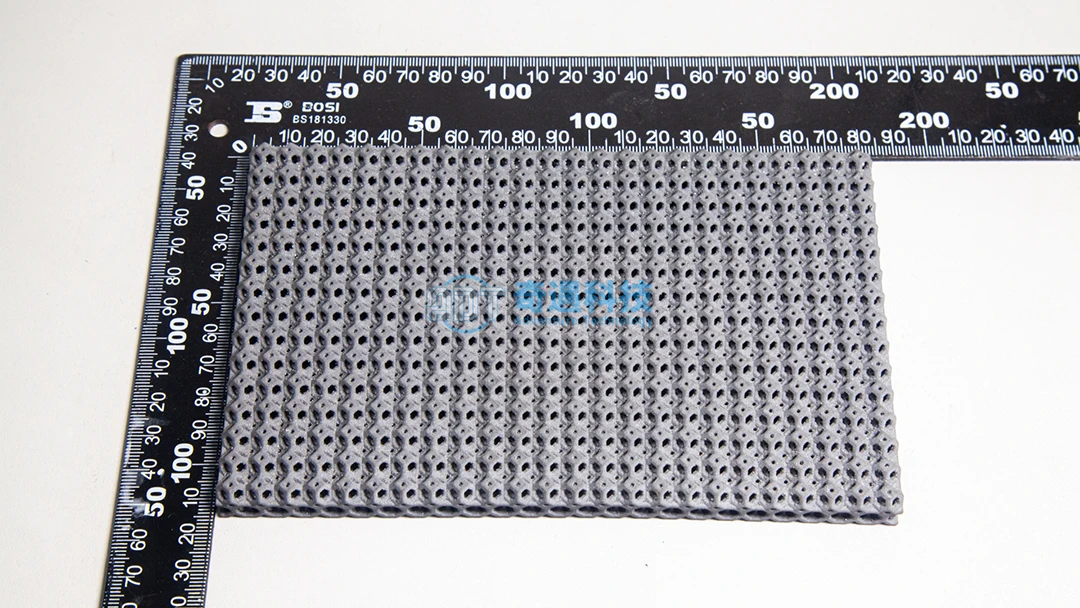
In ceramic manufacturing, there is a quiet failure that has shaped the field for decades.
At the design stage, everything appears stable. Through printing, the structure remains intact. Once finished, hidden failure begins to surface.
A structure that looked perfect in digital form and nearly identical right after DIW ceramic 3D printing suddenly begins to change. It shrinks during drying. It contracts during firing. And worse, it doesn’t shrink evenly.
Edges drift. Internal channels distort. Critical dimensions shift just enough that what was once a precise, engineered geometry becomes something approximated rather than exact.
In most industries, this is an inconvenience. In biomedical implants, it is a deal-breaker.
Because when a ceramic scaffold is meant to match a patient’s bone defect with millimeter precision, “close enough” is not success—it is failure.
For years, the industry accepted this as a fact of life in ceramic 3D printing. You design around it, compensate for it, and machine it afterward.
In other words, you work around the material instead of controlling it.
But a new approach suggests something very different: what if shrinkage is not something you correct—but something you neutralize before it ever happens?
A Different Way to Think About Shrinkage
A research team led by Professor Zeng Yuping at the Shanghai Institute of Ceramics, Chinese Academy of Sciences, recently reported a new approach in Ceramics International titled “Near-net shaping of porous silicon nitride via direct ink writing and reaction bonding.” Using ADT’s precision DIW ceramic 3D printing platform, the team developed a manufacturing strategy that fundamentally rethinks how shrinkage is managed in silicon nitride processing. Rather than attempting to simply minimize deformation during sintering, the process was engineered so that shrinkage and expansion occur simultaneously—and effectively counterbalance one another throughout thermal treatment.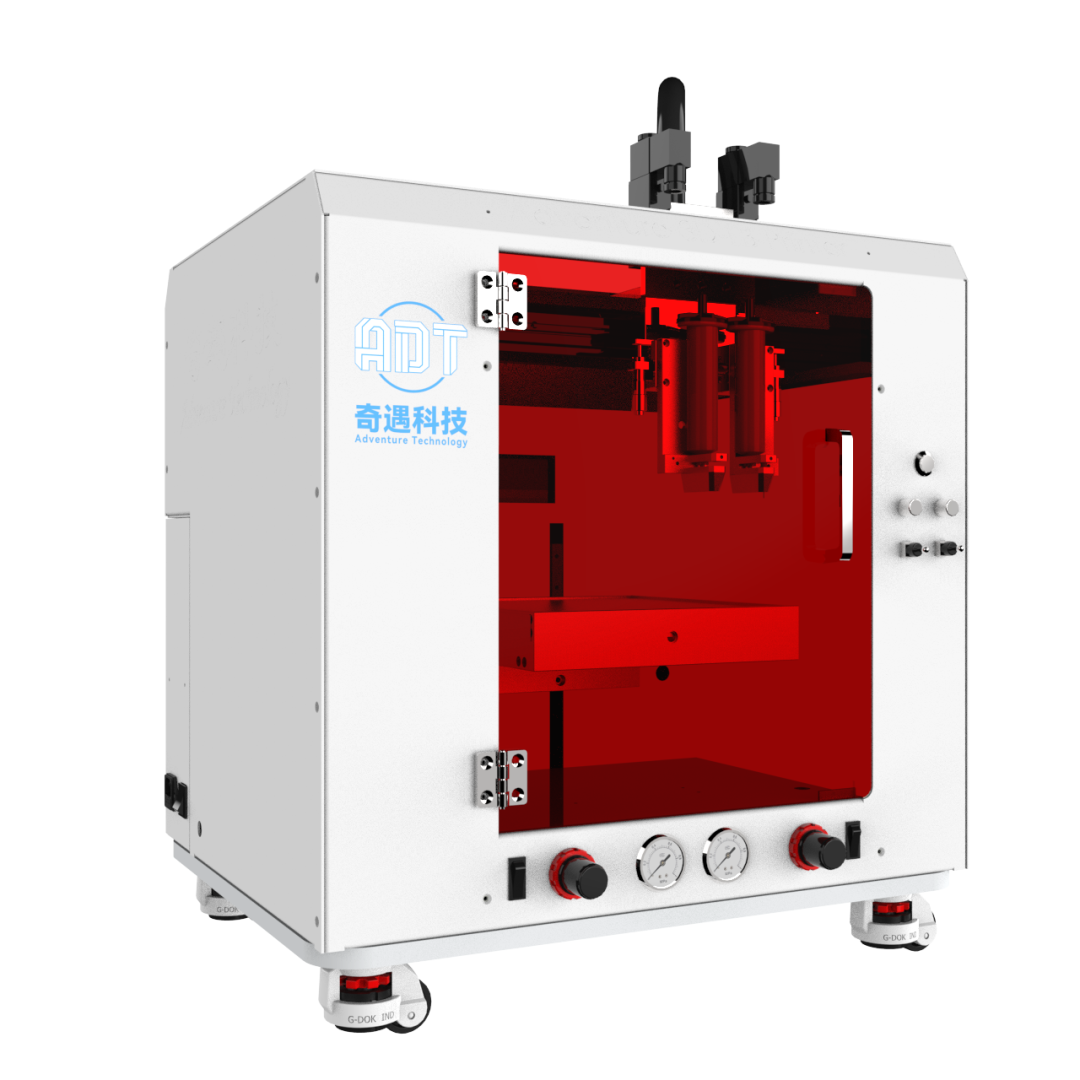
Instead of treating ceramic shrinkage as an unavoidable consequence of sintering, the researchers designed a system where shrinkage and expansion occur at the same time—and cancel each other out.
The material at the center of this idea is silicon nitride, a ceramic already known for its strength, chemical stability, and biomedical compatibility. It is widely considered one of the most promising candidates for load-bearing bone implants.
But its manufacturing problem has always been the same: it is extremely difficult to control dimensionally through thermal processing.
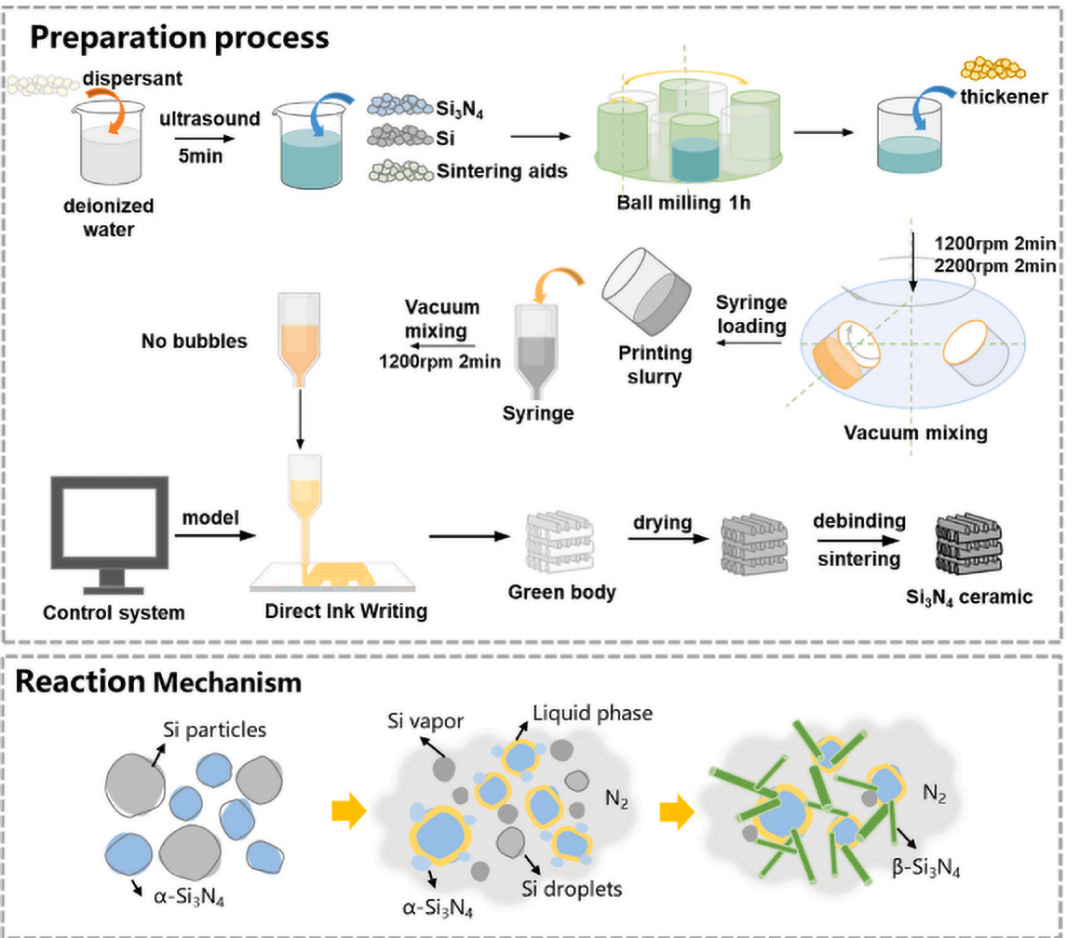
Instead of using only silicon nitride powder, the researchers introduced silicon particles into the system. That decision changes everything about what happens during firing.
At high temperatures in nitrogen, silicon does not remain silicon. It transforms:
Si + N₂ → Si₃N₄
This transformation is not neutral. It expands volume by roughly 21%.
And that is where the strategy becomes interesting.
Because while traditional ceramic sintering pulls structures inward through densification, this reaction pushes them outward through chemical conversion.
Two opposing physical effects begin acting on the same geometry at the same time.
Instead of fighting shrinkage, the system is designed so that shrinkage is continuously counterbalanced by expansion.
What emerges is not reduced deformation, but suppressed net deformation.
When tuned correctly, the final dimensional change drops to below 1%.
At that point, the process significantly suppresses macroscopic dimensional deviation, enabling near-net-shape retention after thermal treatment.
The Step Everyone Used to Ignore—And Why It Matters Most
Even if sintering behavior is stabilized, ceramic manufacturing has another failure point that often gets overlooked: drying.
Before a part ever reaches a furnace, it must survive the removal of liquid from a highly porous structure. And this stage is deceptively destructive.
As water evaporates, it forms curved interfaces between particles. These interfaces generate capillary forces strong enough to pull internal structures inward. In delicate geometries created by ceramic 3D printing, this is often where collapse begins—not in firing, but much earlier.
The researchers bypassed this entirely using freeze-drying.
Instead of letting water evaporate as a liquid, they froze the printed structure so that water transitions directly from solid ice to vapor. Without a liquid phase, the capillary forces never form.
Nothing pulls the structure inward because there is nothing physically “flowing” through it.
What remains is a geometry that is mechanically stable before it ever enters the furnace.
This matters because it changes the role of drying from a destructive stage into a largely passive transition.
Where Geometry Becomes Function
Once dimensional stability is solved, something unexpected happens: material performance becomes easier to design.
At optimized sintering conditions, the silicon nitride develops an interlocking microstructure made of elongated β-phase grains. Instead of a random ceramic network, the structure begins to resemble a self-reinforced architecture at the microscopic.
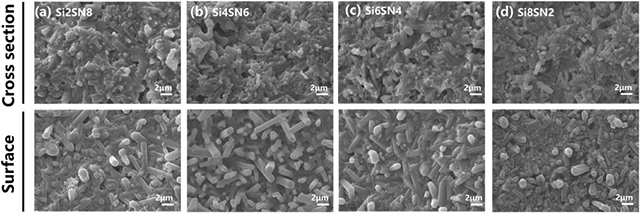
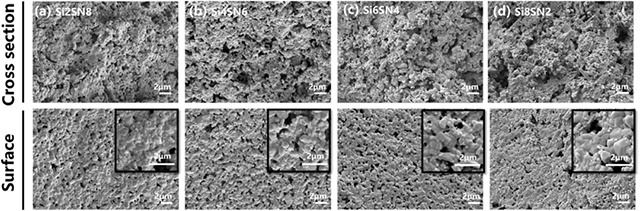
This is where strength comes from. Flexural strength exceeds 230 MPa, placing it within a mechanically promising range for porous structural bioceramics.
But mechanical strength is only part of the story.
As composition and phase content shift, surface behavior changes as well. Higher β-phase content gradually makes the surface more hydrophilic. That small shift has large biological implications.
Cells do not respond to ceramics only in terms of chemistry. They respond to surface energy, wettability, and how proteins initially attach. A more hydrophilic surface tends to support better early-stage cell adhesion—one of the key requirements for bone integration.
So the same system that stabilizes geometry also tunes biological response.
That convergence is not accidental. It is a direct consequence of controlling the material system rather than treating each property separately.
Why This Is a Structural Shift in Ceramic 3D Printing
To understand why this matters, it helps to step back.
Traditional ceramic manufacturing operates on an assumption: distortion is inevitable, so you compensate for it after it happens.
That assumption shapes everything—from design software to machining workflows.
But in this DIW-based ceramic 3D printing approach, the assumption is no longer valid.
Because the material itself is engineered so that the expected failure mode—shrinkage—does not dominate the outcome.
Instead of designing a part and then correcting it, the process is designed so that correction is built into the physics of the system.
That changes the role of manufacturing.
It is no longer a sequence of error and repair. It becomes a single continuous transformation where geometry is preserved rather than reconstructed.
What This Means for Patient-Specific Implants
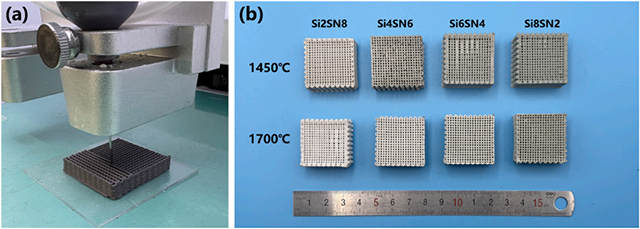
In practical terms, this shift opens a path that has been difficult to achieve in ceramics: true geometric fidelity from scan to implant.
A patient-specific bone defect can be digitally reconstructed, translated into a printable structure, and fabricated through DIW ceramic 3D printing without the usual expectation that it will later need correction or machining to fit.
The critical difference is not just accuracy.
It is predictability.
Because once shrinkage stops behaving like an uncontrolled variable, the reduction in dimensional uncertainty may improve manufacturing predictability.
And in medical applications, determinism is what enables trust.
Closing Thought
Ceramic 3D printing has always been powerful in design but fragile in execution.
What this work suggests is a reversal of that relationship.
Instead of compensating for material behavior, the material is engineered to obey the design intent.
And if that approach scales, silicon nitride may not just become a better implant material—it may become one of the first ceramics that can be reliably manufactured with true digital precision.
This work also highlights the growing role of integrated ceramic additive manufacturing platforms in enabling next-generation materials research.
As a ceramic 3D printing solutions provider, ADT’s DIW platform supported the precise fabrication and process control required for reaction-bonded silicon nitride architectures explored in this study.
Beyond a single material system, the broader significance lies in demonstrating how tightly coordinated printing, drying, and thermal engineering can move ceramic additive manufacturing closer to true near-net-shape production.
For biomedical ceramics and other high-performance applications, that shift may prove increasingly important as the field moves from laboratory feasibility toward reliable industrial implementation.
Reference
This work is based on recent research published in Ceramics International exploring near-net-shape fabrication of silicon nitride through reaction-assisted DIW ceramic 3D printing.
Dai, Y.-L., Yao, D.-X., Xia, Y.-F., Zhu, M., Zhao, J., & Zeng, Y.-P. (2025).
Near-net shaping of porous silicon nitride via direct ink writing and reaction bonding.
Ceramics International, 51(30), 65939–65948.
https://doi.org/10.1016/j.ceramint.2025.11.277 Ceramics International Paper
More articles
Alumina BCC Lattice Ceramic 3D Printing Case Study for Aerospace Research
DIW Ceramic 3D Printing Enables Near-Net-Shape Silicon Nitride Implants with <1% Shrinkage
Oxygen Inhibition in DLP Ceramic 3D Printing: Turning a Printing “Defect” into a Sub-500 μm Precision Advantage